Rechercher dans ce blog

Monday, September 26, 2022

Undercover Cop Hater: New Mexico Congressional Hopeful Uses Fake Name To Trash Cops, Deletes Evidence - Washington Free Beacon

Democrat Gabe Vasquez called to defund police in interview he gave under fake name, investigation shows

New Mexico Democratic congressional candidate Gabe Vasquez and Black Lives Matter supporter 'James Hall' / gabeforcongress.com and screenshot
• September 26, 2022 10:00 am

New Mexico Democrat Gabe Vasquez gave a fake name during an anti-police rant to a journalist at a Black Lives Matter protest in the summer of 2020, a Washington Free Beacon investigation found. Now, the congressional hopeful is burying the evidence.

During a June 2020 Black Lives Matter protest in Las Cruces, N.M., a local reporter interviewed one attendee who furiously expressed his desire to defund police. "We need serious police reform in this country," the man said over chants of "no justice, no peace." "It's not just about defunding police, it's about defunding a system that privileges white people over everyone else." While the interviewee—who shielded much of his face in a hat, neck gaiter, and sunglasses—identified himself as "James Hall," a "Las Cruces resident," the facial features he did show bore a curious resemblance to then-city council member Gabe Vasquez.

That's because the interviewee was, in fact, Vasquez, a former city official who monitored the protest told the Free Beacon. Contemporaneous evidence reviewed by the Free Beacon, meanwhile, supports the assertion. Vasquez tweeted live from the event on June 6, 2020, sharing first-person photos accompanied with the hashtags "BlackLivesMattters [sic]" and "Las Cruces." Six months later, Vasquez shared a photo that showed him sporting the same distinct, teal-and-orange neck gaiter he wore in the interview. That gaiter, the Free Beacon found, is sold by a small New Mexico-based fly fishing business, Where the River Runs. Vasquez is a self-described "avid angler," and in 2018, the Democrat interviewed Where the River Runs founder Gregg Flores on his "conservation podcast," during which Vasquez described a "really cool adventure" he had with Flores through a "project" the pair collaborated on. Vasquez is also a frequent commenter on the company's Facebook page.

Roughly two years after the ordeal, Vasquez has quietly deleted much of the evidence that ties him to the interview, a clear indication that the Democrat feels his impassioned plea to defund police will hurt his bid to unseat Rep. Yvette Herrell (R.) in New Mexico's Second Congressional District. Gone from Vasquez's Twitter are both his live post from the Las Cruces protest and the smiling selfie that shows him wearing the same mask from the protest. Those deletions are recent—both posts were active as of Tuesday.

Vasquez's campaign did not return a request for comment. The former city official who monitored the protest said he and other local officeholders identified Vasquez as soon as they saw the news clip featuring "Hall," citing their interactions with Vasquez when the Democrat served on the city council. "I was disappointed when I saw that because … he was using words that could encourage riots," the former official told the Free Beacon. "Exercise your First Amendment rights, but let's not have harm."

Vasquez may have deleted social media posts linking him to the 2020 protest and interview, but the Democrat's Twitter account still features its fair share of anti-police rhetoric. In June 2020, Vasquez called to "deconstruct and rebuild the systems of oppression that keep black people in perpetual harm," which he said included "law enforcement" and "the economy." Just days earlier, Vasquez said, "As long as white folks … dominate this nation's wealth and preside over our nation's governing bodies & judicial systems, the racism, killing, & injustice will continue."

Vasquez also expressed interest in cutting police budgets during his time on the Las Cruces City Council, though his statement was much more restrained when compared with his protest interview.

"If we do have to take budget away from specific department[s], whether it be police or otherwise—I don't think we have to, because we have a budget that I think can support that currently," Vasquez, who served on the city council from 2017 to 2021, said in a September 2020 interview. "But we also have to look at where the inefficiencies are, where the redundancies are, where we would not rather respond with force or with police. And, you know, if we don't need those positions anymore … then we need to get rid of them, and that's a decision I'm happy to try to champion at the city council." Vasquez's campaign site now says that "police reform, not police defunding, is the right way to move forward."

Vasquez launched his congressional run in September 2021, touting his "proven record of fighting for New Mexicans." He will face Herrell in November after defeating his Democratic primary opponent, Darshan Patel, by 56 points in June. Vasquez has raised $1.2 million to Herrell's $2.7 million.

Adblock test (Why?)


Undercover Cop Hater: New Mexico Congressional Hopeful Uses Fake Name To Trash Cops, Deletes Evidence - Washington Free Beacon
Read More

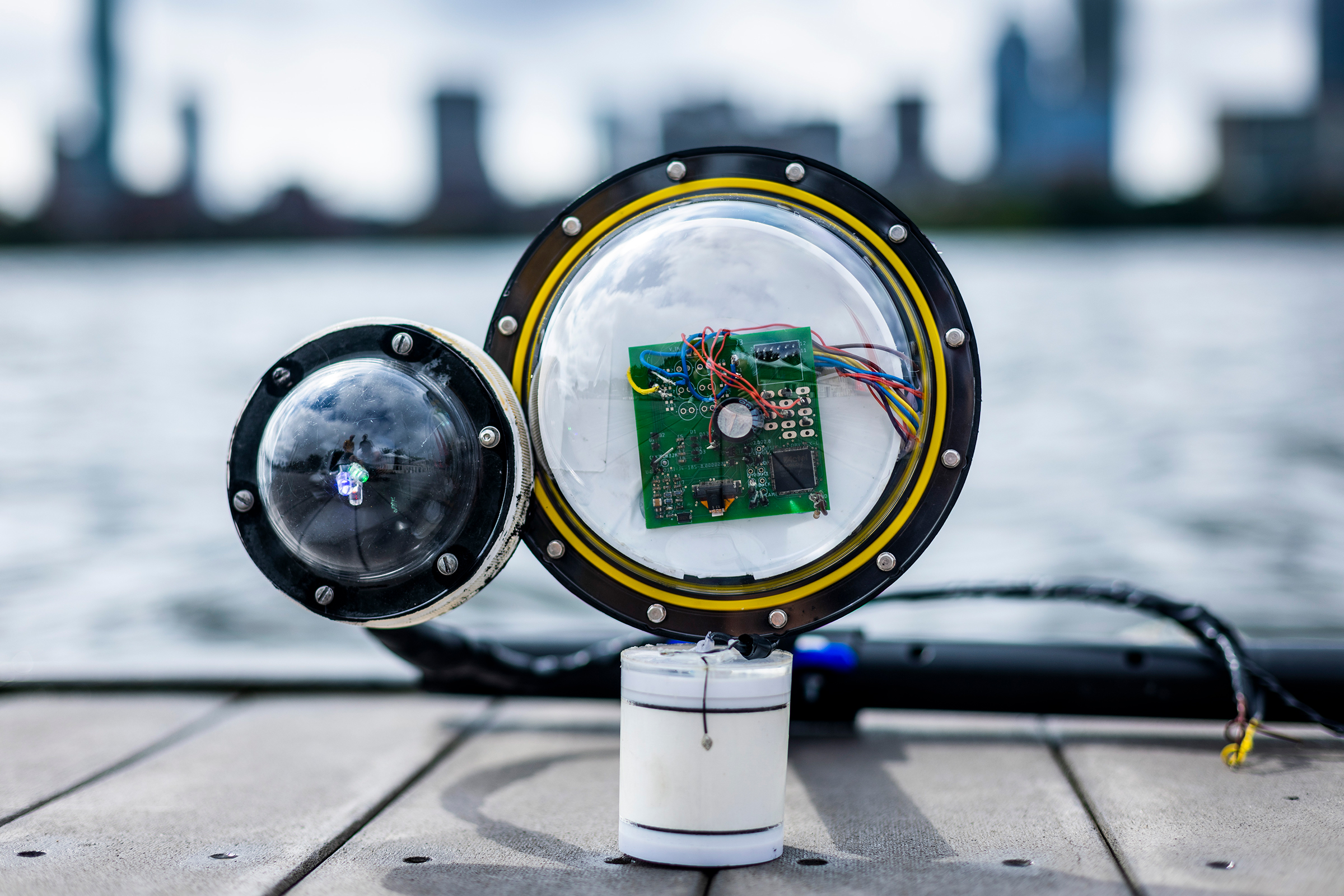
MIT engineers build a battery-free, wireless underwater camera - MIT News

Scientists estimate that more than 95 percent of Earth’s oceans have never been observed, which means we have seen less of our planet’s ocean than we have the far side of the moon or the surface of Mars.

The high cost of powering an underwater camera for a long time, by tethering it to a research vessel or sending a ship to recharge its batteries, is a steep challenge preventing widespread undersea exploration.

MIT researchers have taken a major step to overcome this problem by developing a battery-free, wireless underwater camera that is about 100,000 times more energy-efficient than other undersea cameras. The device takes color photos, even in dark underwater environments, and transmits image data wirelessly through the water.

The autonomous camera is powered by sound. It converts mechanical energy from sound waves traveling through water into electrical energy that powers its imaging and communications equipment. After capturing and encoding image data, the camera also uses sound waves to transmit data to a receiver that reconstructs the image. 

Because it doesn’t need a power source, the camera could run for weeks on end before retrieval, enabling scientists to search remote parts of the ocean for new species. It could also be used to capture images of ocean pollution or monitor the health and growth of fish raised in aquaculture farms.

“One of the most exciting applications of this camera for me personally is in the context of climate monitoring. We are building climate models, but we are missing data from over 95 percent of the ocean. This technology could help us build more accurate climate models and better understand how climate change impacts the underwater world,” says Fadel Adib, associate professor in the Department of Electrical Engineering and Computer Science and director of the Signal Kinetics group in the MIT Media Lab, and senior author of a new paper on the system.

Joining Adib on the paper are co-lead authors and Signal Kinetics group research assistants Sayed Saad Afzal, Waleed Akbar, and Osvy Rodriguez, as well as research scientist Unsoo Ha, and former group researchers Mario Doumet and Reza Ghaffarivardavagh. The paper is published today in Nature Communications.

Going battery-free

To build a camera that could operate autonomously for long periods, the researchers needed a device that could harvest energy underwater on its own while consuming very little power.

The camera acquires energy using transducers made from piezoelectric materials that are placed around its exterior. Piezoelectric materials produce an electric signal when a mechanical force is applied to them. When a sound wave traveling through the water hits the transducers, they vibrate and convert that mechanical energy into electrical energy.

Those sound waves could come from any source, like a passing ship or marine life. The camera stores harvested energy until it has built up enough to power the electronics that take photos and communicate data.

To keep power consumption as a low as possible, the researchers used off-the-shelf, ultra-low-power imaging sensors. But these sensors only capture grayscale images. And since most underwater environments lack a light source, they needed to develop a low-power flash, too.

“We were trying to minimize the hardware as much as possible, and that creates new constraints on how to build the system, send information, and perform image reconstruction. It took a fair amount of creativity to figure out how to do this,” Adib says.

They solved both problems simultaneously using red, green, and blue LEDs. When the camera captures an image, it shines a red LED and then uses image sensors to take the photo. It repeats the same process with green and blue LEDs.

Even though the image looks black and white, the red, green, and blue colored light is reflected in the white part of each photo, Akbar explains. When the image data are combined in post-processing, the color image can be reconstructed.

“When we were kids in art class, we were taught that we could make all colors using three basic colors. The same rules follow for color images we see on our computers. We just need red, green, and blue — these three channels — to construct color images,” he says.

Sending data with sound

Once image data are captured, they are encoded as bits (1s and 0s) and sent to a receiver one bit at a time using a process called underwater backscatter. The receiver transmits sound waves through the water to the camera, which acts as a mirror to reflect those waves. The camera either reflects a wave back to the receiver or changes its mirror to an absorber so that it does not reflect back.

A hydrophone next to the transmitter senses if a signal is reflected back from the camera. If it receives a signal, that is a bit-1, and if there is no signal, that is a bit-0. The system uses this binary information to reconstruct and post-process the image.

“This whole process, since it just requires a single switch to convert the device from a nonreflective state to a reflective state, consumes five orders of magnitude less power than typical underwater communications systems,” Afzal says.

The researchers tested the camera in several underwater environments. In one, they captured color images of plastic bottles floating in a New Hampshire pond. They were also able to take such high-quality photos of an African starfish that tiny tubercles along its arms were clearly visible. The device was also effective at repeatedly imaging the underwater plant Aponogeton ulvaceus in a dark environment over the course of a week to monitor its growth.

Now that they have demonstrated a working prototype, the researchers plan to enhance the device so it is practical for deployment in real-world settings. They want to increase the camera’s memory so it could capture photos in real-time, stream images, or even shoot underwater video.

They also want to extend the camera’s range. They successfully transmitted data 40 meters from the receiver, but pushing that range wider would enable the camera to be used in more underwater settings.

“This will open up great opportunities for research both in low-power IoT devices as well as underwater monitoring and research,” says Haitham Al-Hassanieh, an assistant professor of electrical and computer engineering at the University of Illinois Urbana-Champaign, who was not involved with this research.

This research is supported, in part, by the Office of Naval Research, the Sloan Research Fellowship, the National Science Foundation, the MIT Media Lab, and the Doherty Chair in Ocean Utilization.

Adblock test (Why?)


MIT engineers build a battery-free, wireless underwater camera - MIT News
Read More

Sunday, September 25, 2022

New British Chancellor Kwasi Kwarteng Reverses Rishi Sunak’s Scrapping Of Tax-Free Shopping For International Tourists - Forbes

Free beekeeping, gardening and sustainability classes this fall - SILive.com

STATEN ISLAND, N.Y. — The Lenni-Lenape, who once lived off the region’s land, thrived despite scorching summers, frigid temperatures and the occasional hurricane. And the modern day people of Staten Island can do so as well with a little help from the Parks Department.

Aly Stoffo, aka the Glam Gardener, will host a free series through the Staten Island-based NYC Parks Department Greenthumb Grows Community Garden on Sunday, Oct. 2 from 2 p.m. to 5 p.m. It takes place at the Hill Street Garden at 50 Hill St., Stapleton.

Fabulous food folks

Aly Stoffo is the Glam Gardener NYC, maven of foraging from the wild. (Staten Island Advance/Pamela Silvestri)(Staten Island Advance/Pamela Si

Stoffo explained, “I received a Staten Island Arts grant to host this free community event that will offer five workshops all around gardening, nature, art, and sustainability. We’re having a beekeeping demonstration, botanical dying, foraging tour, gardening tour, yoga and mindfulness, and a fortune telling workshop using the tea of leaves based on an ancient art.”

She encouraged, “This event invites all ages and walks of life.”

The afternoon is broken down into five segments. Guests can attend one, all or a few but an RSVP is necessary through glamgardenernyc.com. Sessions are as follows:

2:15 to 3 p.m. — Garden and Foraging Tour

3 to 4 p.m. — Fortune Telling in the Leaves of Tea

4 to 4:30 p.m. — How Honey Is Made and Beekeeping Demonstration

4:45 to 5:30 p.m. — Botanical Fabric Dying with Flowers & Plants

5:30 to 6 p.m. — Gentle Yoga & Mindful Movement with Be Yoga

Stoffo says, “This event is a celebration of community and all things green, a skill-share event where you can learn a thing or two, and an opportunity for you to taste some locally grown goodness.”

Pamela Silvestri is Advance Food Editor. She can be reached at silvestri@siadvance.com.

Adblock test (Why?)


Free beekeeping, gardening and sustainability classes this fall - SILive.com
Read More

‘Rick and Morty’ season 6, episode 4: How to watch for free (9/25/22) - cleveland.com

Ask an adult sci-fi fan about the cartoon “Rick and Morty” and their face lights up. Now in its sixth season, the series has serious fans. The new season 6 is on its fourth episode of 10. The show drops Sunday, Sept. 25 at 11 p.m. Eastern on Cartoon Network.

HOW TO WATCH FOR FREE: DirecTV Stream (free trial), Hulu (free trial). Also, Sling has promotional offers. Previous seasons can be streamed on HBO Max.

This adult, science-fiction cartoon follows the adventures of mad scientist Rick and his grandson Morty as they have interdimensional adventures across multiple realities. A new episode is released every Sunday night.

HBO Max summarize “Rick and Morty” as follows: A sociopathic scientist arrives at his daughter’s doorstep 20 years after disappearing and moves in with her family, setting up a laboratory in the garage and taking his grandson on wild adventures across the universe.

Adblock test (Why?)


‘Rick and Morty’ season 6, episode 4: How to watch for free (9/25/22) - cleveland.com
Read More

2022 Presidents Cup TV schedule, coverage, live stream, watch online, streaming free, times, dates - CBS Sports

presidents-cup-2022-flag-g.png
Getty Images

The 2022 Presidents Cup continues this week in Charlotte with the United States flexing its might as it attempts to win its ninth straight trophy dating back to 2005. The Americans are trying to win their fifth straight Presidents Cup on home soil, while the International team is seeking its first victory since 1998 (or perhaps at least its first tie since 2003).

The U.S. was a heavy favorite entering this year's event at Quail Hollow Golf Club, and the belief in its victory only soared after play on Thursday and Friday as the Americans took a huge 8-2 advantage. However, the international side bounced back in a big way on Saturday thanks to the efforts of rising star Tom Kim. The 20-year-old turned in a breakout performance, willing his team back into contention and setting up an interesting Sunday as opposed to waiting for a U.S. blowout to conclude

Here's a look at the 2022 Presidents Cup schedule of events so you can watch the action all week long. Check out pairings and tee times for Day 1, and follow live Presidents Cup scores and results throughout the day.  All times Eastern

2022 Presidents Cup TV schedule

Day 4 -- Sunday, Sept. 25

Session 5 (Singles): 12 p.m.

TV coverage: 12-6 p.m. on NBC
Live stream: 12-6 p.m. on fuboTV (Try for free)

Adblock test (Why?)


2022 Presidents Cup TV schedule, coverage, live stream, watch online, streaming free, times, dates - CBS Sports
Read More

All the News That Gives You Fits - Washington Free Beacon

In August, researchers writing in the journal Health Communication reported findings from a study of media consumption habits. In results that will come as no surprise to anyone who has spent five minutes on Twitter, they found that Americans who engaged in "problematic media consumption"—that is, excessive amounts of news viewing online, in print, and on television—experienced harmful mental health effects as well as disruptions to sleep and in their personal interactions with others. "While we want people to remain engaged in the news, it is important that they have a healthier relationship with the news," one of the researchers noted in a press release.

Thankfully, Chris Stirewalt is here to help. In Broken News: Why the Media Rage Machine Divides America and How to Fight Back, the former Fox News Channel political editor and current fellow at the American Enterprise Institute offers a sharply observed and at times hilarious journey through our contemporary media ecosystem, with particular focus on how Americans helped build and now gleefully participate in the running of the "rage machine" of the book’s subtitle. (Full Disclosure: I recently became a colleague of Stirewalt’s at AEI.)

For a book about an industry riven by political strife, Broken News is refreshingly free of partisan cant. In fact, Stirewalt makes clear that the problems facing journalism impact everyone on the political spectrum: "What is wrong with my vocation and the industry in which I work is harming Americans left, right, and center," he argues.

Why are we so angry and polarized? Stirewalt traces the shift from print to radio to television to the Internet and the challenges these different modes of communication pose to civic health. He describes how these developments contributed to the growth of national media, often at the expense of local news. And he argues passionately for the importance of healthy media for American life. "The American Creed requires written words and a common culture in which to understand them," Stirewalt argues. Today, however, "much of our news does not aim to make ideas understood, but to generate powerful feelings—often fear, anger, and resentment."

Stirewalt reminds readers of historical moments when those shifts occurred, such as the radio reporter who said, "oh, the humanity," while describing the Hindenburg disaster. "The listener is connected not to the event itself, but to the reporter’s reaction to the event," Stirewalt notes. As a result, "the news consumer is passively receiving emotional meaning." We remember the emotional response as much if not more than the event that provoked it.

That’s because emotion sells, particularly fear, anger, anxiety, and hate. "The hatred people feel for their fellow Americans is not just a by-product of political coverage," Stirewalt argues, "but a necessary component of making much of that coverage profitable." Media institutions are now in the business of "optimizing for anger," as one writer described the transformation in tone of the coverage offered by the Washington Post during Donald Trump’s presidency. Stirewalt is appropriately critical of the mainstream media for its initial flirtation and ultimately masochistic embrace of our former president; Fifty Shades of Donald Trump proved too lucrative and salacious a franchise for media companies to resist. "Ronald Reagan and Bill Clinton were both good on television," Stirewalt writes. "Trump was television."

"Balanced, thoroughly reported news is hard to do, expensive, and often boring," Stirewalt reminds us. "Tribal outrage is easy, cheap, and entertaining." It is also deeply appealing to baser human instincts—and we’ve perfected technologies and platforms that make its expression seamless. When people log on to Twitter they no doubt think of themselves as thoughtful, rational Lockeans. As soon as they see a provocative Tweet from a political opponent, however, they are off to the land of Hobbes.

Stirewalt has firsthand experience with the consequences of this new style of journalism. He was fired from Fox News after he made the Decision Desk call that Joe Biden had won Arizona on election night 2020. Fox News viewers and even Donald Trump protested loudly on social media about the call, even though it was the correct one. "Fox viewers had become even more accustomed to flattery and less willing to hear news that challenged their expectations," he notes, with admirable equanimity toward his former employer.

Stirewalt describes other contributing factors to our broken media institutions, such as the decline of power of the respective political parties, which exacerbates partisanship, as well as the way media reward the pursuit of fame by so many of our elected officials. "If Representative Alexandria Ocasio-Cortez really wanted to raise taxes on the wealthy, she wouldn’t do it by writing ‘tax the rich’ on her rump and going to the Met Gala," Stirewalt notes. "But if she wants to be famous for wanting to raise taxes on the wealthy, then she’s right on track." This, too, is a bipartisan affliction, as the careers of Rep. Matt Gaetz and Rep. Marjorie Taylor Greene demonstrate.

Throughout the book, Stirewalt rejects the effort by journalists to practice "post-journalism," which focuses on generating emotional responses (and attachment) from users and a sense of group identity based on shared values rather than on reporting the facts. Its close cousin is "moral clarity" journalism, which argues that journalists should abandon objectivity for the larger goal of writing stories that further whatever social justice causes they want to champion.

I would like to have heard more of Stirewalt’s thoughts on how cultural trends impact what people want from media. We’ve raised several generations of Americans who believe life can and should give them what they want on demand and who believe their opinion on everything matters (but who also believe that any challenge to what they say is a form of violence). Twitter makes everyone their own editorial-page editor, all day, every day, in real time. Endless opportunities to argue online have clearly not strengthened the bonds of our union, yet we continue to spend large amounts of time doing it.

As for solutions, Stirewalt offers several excellent ones; call them Stirewalt’s Rules of Reporting, and if you are an aspiring journalist, memorize them. I would summarize the best of them as follows:

Journalists should take the practice of journalism more seriously, and themselves a great deal less so.

Practical experience reporting on the mundane details of municipal government is far more valuable than faddish pursuits like "moral clarity" journalism. Practice, not theory. Reporting, not opining. Facts, not over-emotional apocalypticism.

Strengthen local news coverage. Resist the temptation to see every issue and idea through a national news lens. Report on what is happening in places that coastal elites and large media companies too often ignore. If all politics is local, then more journalism needs to be local as well.

There are many more lessons buried in this wonderful book: Journalists should stop relying so much on anonymous sources. News consumers should stop demanding that political reporting sound like a Real Housewives altercation. Journalists should stop acting like meat renderers, picking over the carcass of partisan politics looking for usable scraps, and instead pursue the ideal of objectivity, even if they fail to reach it.

And, most importantly, don’t make everything political. This way leads to moral immiseration.

George Orwell hovers as a patron saint throughout the book, and Stirewalt cites him as a warning of the dangers of an information environment where lies are accepted as truth. Stirewalt is more of an optimist than Orwell, but his message is just as important: We can’t abandon journalism to the forces of cynicism and anger. We need it. We need a healthy media environment because when journalism is done well, it serves an important civic purpose. It reminds us that despite our differences and disagreements, we must find a common purpose, a common story—only then can we fully appreciate the remarkable freedoms we enjoy.

Broken News: Why the Media Rage Machine Divides America and How to Fight Back
by Chris Stirewalt
Center Street, 256 pp., $29

Christine Rosen is a senior fellow at the American Enterprise Institute and media columnist for Commentary magazine. 

Adblock test (Why?)


All the News That Gives You Fits - Washington Free Beacon
Read More

Blue Jays manager John Schneider saves woman choking at lunch, given free beer by restaurant - Fox News

Toronto Blue Jays manager John Schneider sprung to action when he saw a woman choking on food while at a lunch with his wife near the team’...